Introduction
You’ve got a great farm. You produce excellent products. But in today’s crowded marketplace, that’s often not enough. The difference between a farm that sells produce and a farm that builds a loyal following is simple: storytelling.
According to marketing experts, farms that communicate standards, their ethos, and the story behind their products build the deepest connections with customers. A purchase becomes more than just a transaction — it becomes a relationship . It sounds soft, but it’s backed by hard science: our brains are wired to remember stories 22 times more than isolated facts. Stories trigger emotion and logic. They spark action. They linger .
You don’t need to be a professional writer or content creator to do this. The raw material for powerful storytelling is already all around you: your daily work, your challenges, your animals, your land, and the people who make it all happen. This guide will show you how to find, shape, and share those stories to build a brand that stands out.
H2: The Power of Narrative: Why “Just the Facts” Isn’t Enough
In agriculture, we often default to “just the facts.” We talk about yields, weights, prices, and specifications. But as the African Food Changemakers community points out, “impact without a story is forgettable” .
H3: Stories Build Emotional Connections
Hayley Parker, managing director of Flame Marketing, argues that sustainability and other farming practices are “powerful ways to build your farm brand and set yourself apart,” but only if you make them part of your story . When you share why you do what you do, customers connect with your values, not just your product.
H3: Stories Differentiate Your Brand
Rick Harrison, CEO of Farm Trader, emphasizes that farmers need to “set themselves apart and grab the buyer’s attention in an emotional way.” Marketing that makes people laugh, think, or feel something sticks in their memory much longer .
H3: Stories Build Trust
Jeremy Buxton of Eve’s Hill Farm advises being fully transparent: “If a customer asks a question, we answer it forthrightly. Tell them your story, education is critical” . Consumers are skeptical. Honest stories that don’t shy away from your practices (like Carla Schultz explaining why she uses GMOs to Detroit farmers market shoppers) build a reputation for transparency that is incredibly valuable .
H2: The Six Essential Elements of a Great Farm Story
Whether you’re writing a blog, filming a video, or posting on social media, every compelling story has some key ingredients.
H3: 1. A Relatable Character
Stories are about people, not products. Your characters can be yourself, your family, your employees, or even your customers .
Ideas:
- “Meet Our Herd Manager: A Day in the Life of Sarah”
- “My Grandfather’s Journey to This Land”
- “Why My Kids Love Growing Pumpkins”
H3: 2. A Clear Conflict
Good stories involve a challenge. What problem did you face and overcome? This is where the audience can relate.
Ideas:
- “The Year the Drought Nearly Broke Us”
- “How We Solved Our Weed Problem Without Chemicals”
- “The Bureaucratic Red Tape That Almost Killed Our Farm Shop”
H3: 3. The Resolution
How did you solve the problem? This provides value and shows your competence.
Ideas:
- “The Cover Crop That Changed Everything”
- “How We Built Our Own Automated System”
- “Lessons Learned from the Worst Season”
H3: 4. Emotion
The heartbeat of your story. Let the passion, frustration, and joy of farm life show. “People want to feel something. They don’t want to be sold a product,” notes one successful farm content creator .
H3: 5. Authenticity
Drop the buzzwords. As Jesse Frost of No-Till Growers emphasizes, audiences respond to “honesty and vulnerability.” Sharing your mistakes and challenges can build even more trust than only showing successes .
H3: 6. The Hero’s Journey (Your Customer)
Frame your customer as the “hero” and your farm as the “guide.” How did your product help them (or will it help them) overcome a challenge? The story of how a customer uses your produce for a perfect family dinner is more powerful than just saying “Buy our tomatoes.”
H2: Real-World Stories: Lessons from Successful Farmers
Let’s move from theory to practice. Here are concrete examples of farms and individuals using storytelling to thrive.
H3: Eve’s Hill Farm (Norfolk, UK): Community and Education
Jeremy and Kathryn Buxton run a 100ha holding with a Hereford suckler beef herd, a farm shop, camping, and a popular farmers’ market. Their marketing strategy is built on education and community .
Storytelling Strategies:
- Tell the story of your standards: They don’t just sell beef; they explain why they produce grass-fed beef.
- Anticipate questions: They use FAQs on their website to tell the story of the farm and directly address customer concerns .
- Educate the next generation: They host school visits, guided tractor tours, and stamp trails for children. These are “customers of the future” .
H3: Strawberry Fields (Devon, UK): Loyalty as a Story
Laura Mounce runs a diversified family farm with shops, a café, and a restaurant. They are fiercely protective of their brand and use loyalty programs to build a deeper story with their customers .
Storytelling Strategies:
- Collect data to tell the story back: A free loyalty card scheme lets them target customers differently, offering personalized discounts and priority offers .
- Customers as co-creators: They use events as photo opportunities, encouraging customers to share their own photos and market the farm for them .
- High standards as a brand story: Their high standards extend through produce, meals, and service. The story is: “When you buy from us, you are buying quality” .
H3: Ag With Emma: The Personal Adventure Story
Emma (“Ag with Emma”) started by posting about her job in seed production so her family could see what she was doing. It grew into a massive following documenting her adventures, including working on a custom-harvesting crew and visiting farms across the world .
Storytelling Strategies:
- Take people with you: By documenting her daily life on the combine, crop scouting, or visiting farms, she gives people a front-row seat to the world of agriculture .
- Show, don’t tell: Her content style is immersion. She doesn’t just talk about farming; she shows the sights and sounds of the harvest from the cab.
- Inspire others: She focuses on her end goal: “I love inspiring people to get into agriculture” .
H3: Carla Schultz: The Relatable, Honest Expert
Carla Schultz sells meat directly to consumers in Detroit. Her storytelling is based on honesty and transparency in the face of consumer skepticism about GMOs .
Storytelling Strategies:
- Face the conflict directly: Some consumers are scared of GMOs. Schultz doesn’t avoid it. She explains, “This is why we do what we do. I’m not going to hide this” .
- Make the technical personal: She explains why they feed GMO corn to their animals, connecting it to the ethanol market and the economics of the farm. She also invites people to visit the farm, so they can see with their own eyes that “you do care for your animals” .
- Use your platform to change perceptions: She volunteers in classrooms to tell the story of modern food production to the next generation.
H2: How to Build Your Storytelling Strategy
You’ve got the raw material and you’ve seen the examples. Now let’s build a system.
H3: Identify Your Core Stories
Sit down and list the stories you can tell. Ask yourself:
- Why did we start farming? (The origin story)
- What are we most proud of? (The achievement story)
- What was our biggest challenge and how did we overcome it? (The resilience story)
- Who are our customers and how do they use our products? (The community story)
- What is a typical day like on our farm? (The behind-the-scenes story)
H3: Choose Your Format
Not all stories are best told in the same way.
- Written (Blog/Newsletter): Good for in-depth explanations, recipes, and detailed histories.
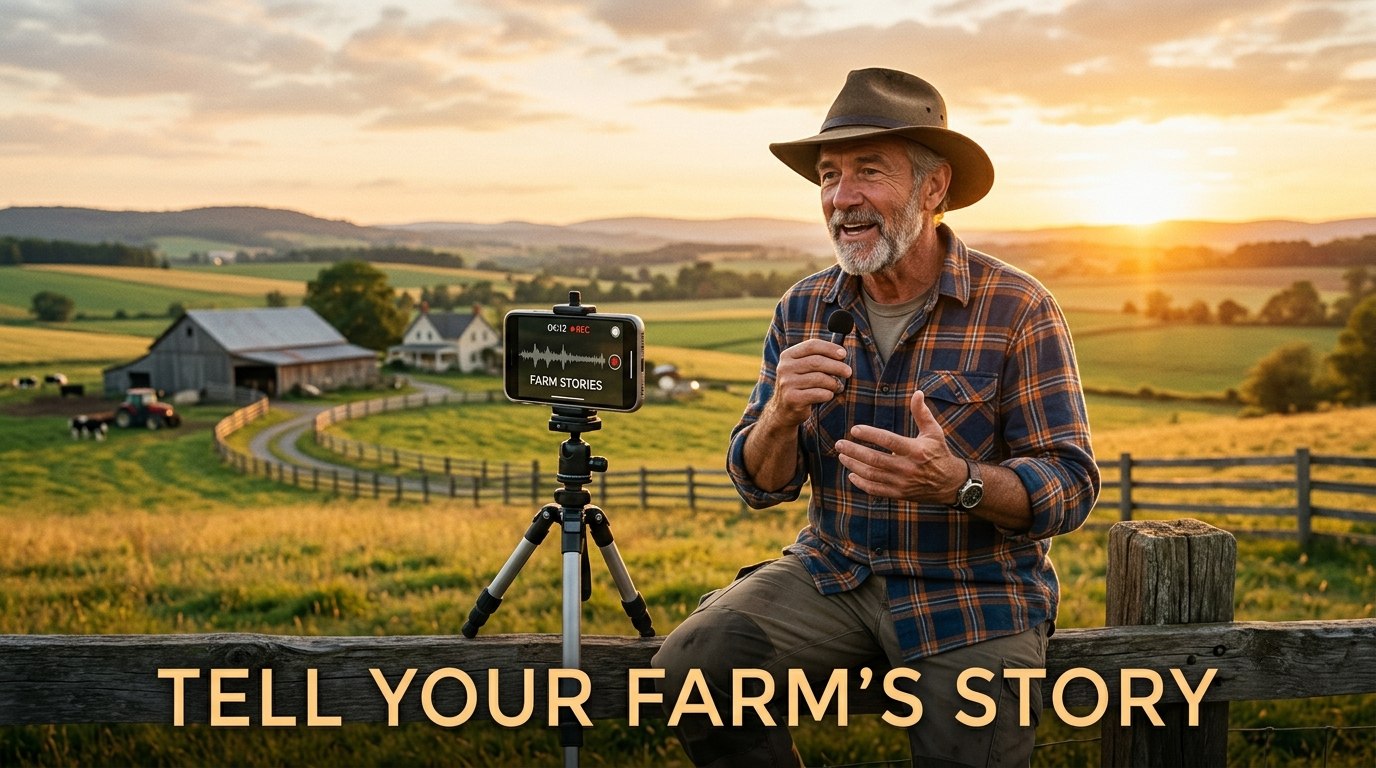
- Video (Social Media, YouTube): Best for showing processes, and capturing the sights and sounds of the farm, and personalizing your team .
- Audio (Podcast): Excellent for interviews and diving deep into a topic your community cares about .
H3: Map Stories to Your Business Goals
Think about the buying journey and ensure your stories are moving people along.
- To build awareness: Tell your origin story, share a stunning time-lapse, or create an entertaining video about farm life. To grab attention quickly (especially on TikTok or Instagram Reels), ensure your video has a strong hook in the first three seconds .
- To build trust: Use transparency stories like Carla Schultz, or educational content that proves your expertise.
- To close a sale: Use customer spotlight stories, showing real people using and loving your product.
H3: Invite Your Customers to Contribute
Storytelling doesn’t have to be a monologue. As Hayley Parker suggests, “offer a photo spot at your business, they will post their pictures and do some of your marketing for you” . “Invite your customers to engage,” and consider offering rewards for reviews. The more engaged they feel, the more they’ll promote your farm .
H2: Conclusion
In a world of choice, people don’t just buy a product; they buy the story, the ethos, and the people behind it. Agriculture is not a dry commodity business. It is one of the most human and story-rich industries on the planet, full of passion, challenge, and triumph. You are not just a farmer; you are a custodian of a story that people need to hear. Tell it well, and you will build a brand that lasts.