Introduction
Let’s be real for a moment. Farming is unpredictable. Droughts, floods, market crashes, supply chain disruptions, rising input costs — the list of challenges seems to grow longer every season. And when things get tough, marketing often becomes the first thing farmers stop doing.
“We’ll focus on marketing when things settle down,” we tell ourselves.
But here’s the uncomfortable truth: the best time to build your brand is when times are tough. Why? Because your customers are still out there. Your competitors might be scaling back, creating a vacuum you can fill. And the farmers who do keep showing up — consistently, authentically — are the ones who are remembered when the good times return.
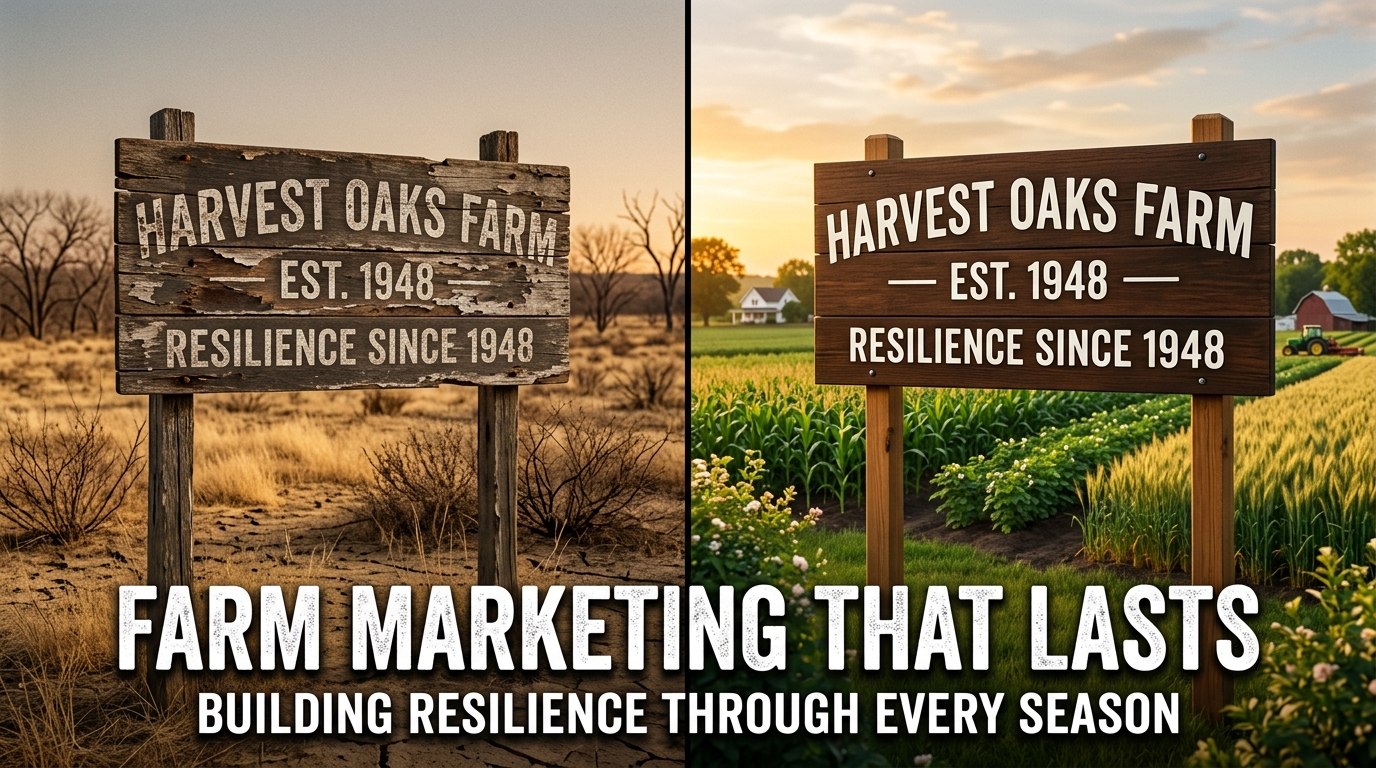
This guide is about building a resilient agricultural brand. Not a fair-weather brand that only shows up when the sun is shining and commodity prices are high. A brand that weathers the storms, builds genuine trust, and emerges stronger on the other side.
H2: What Makes an Agricultural Brand Resilient?
Before we dive into tactics, let’s define what we mean by “resilient” in the context of farm marketing.
H3: The Four Pillars of Resilience
1. Authenticity
You can’t fake it on a farm. Consumers are increasingly savvy and can spot inauthenticity from a mile away. A resilient brand is built on genuine values, real stories, and honest communication.
2. Diversification
Putting all your marketing eggs in one basket (like relying solely on one buyer or one social media platform) is risky. Resilient brands spread their presence across multiple channels and customer segments.
3. Community Connection
Strong relationships with customers, neighbours, suppliers, and industry peers provide a buffer during tough times. People support people they know and trust.
4. Adaptability
The ability to pivot when circumstances change — whether that’s shifting from wholesale to direct sales, or changing your content focus to meet new customer needs — is the hallmark of a resilient brand.
H2: When the Going Gets Tough — Marketing Strategies That Work
H3: Communicate Early and Honestly
When challenges hit — whether it’s a drought, a disease outbreak, or supply issues — your customers need to hear from you.
What to do:
- Be transparent: If you’re facing challenges, share them (appropriately). Customers respect honesty. “We’re experiencing [challenge] and here’s what we’re doing about it.”
- Manage expectations: If you can’t fulfil orders as usual, tell people early. They’ll appreciate the heads-up.
- Show your resilience: Share how you’re adapting. This builds confidence in your brand.
Example:
“We’re in the middle of a dry spell that’s affecting our pasture growth. To protect our soil and animals, we’re adjusting our grazing rotation and bringing in supplementary feed. This means our lamb numbers will be slightly lower than usual this season, but the quality will remain high. Thank you for your understanding and support.”
H3: Focus on Value, Not Price
In challenging economic times, there’s a temptation to compete on price. Resist it. Instead, compete on value.
What to do:
- Emphasise quality: Remind customers why your product is worth the price — taste, freshness, traceability, ethical practices.
- Share your story: When times are tough, your story becomes even more important. It reminds customers why they chose you in the first place.
- Add value: Can you offer recipes, storage tips, or preparation advice? This extra value justifies your premium pricing.
H3: Double Down on Customer Relationships
When you’re stressed about the farm, customer relationships can feel like extra work. But in tough times, they’re your lifeline.
What to do:
- Check in personally: Send a text or email to your regular customers. Not to sell — just to check in.
- Listen actively: What are your customers worried about? What do they need right now? Adjust your offerings accordingly.
- Show gratitude: A simple “thank you for sticking with us” goes a long way.
Key Insight: “If there’s one thing I’ve learned, it’s that people buy from people. The relationships you build during hard times are worth ten times more than any transaction during good times.”
H3: Diversify Your Income Streams and Promotion Channels
We’ve already mentioned diversification as a pillar of resilience. Here’s how to put it into practice:
| Current | Diversified |
|---|---|
| One major buyer | Multiple buyers + direct-to-consumer sales |
| One product line | Multiple products or value-added offerings |
| One platform (e.g., Facebook) | Facebook + Instagram + email newsletter + local markets |
| Wholesale only | Wholesale + farmers markets + online store + farm gate sales |
Start small: You don’t need to implement everything at once. Pick one new channel or product to develop this season.
H2: Content That Builds Resilience
The content you create during challenging times shapes how people perceive your brand for years to come. Here are specific content ideas that build resilience:
H3: 1. Behind-the-Scenes During the Struggle
Don’t hide the tough stuff. Show it. This is where real trust is built.
Post ideas:
- “What a dry season looks like on our farm”
- “How we’re keeping our animals comfortable in the heat”
- “The things we do differently when times are tough”
- “A walk through a paddock that’s struggling — and what we’re doing about it”
Why it works: It demonstrates your resilience and commitment. It shows you care enough to adapt. And it humanises you — your customers see you as a real person, not just a producer.
H3: 2. Educational Content That Addresses Current Challenges
If you’re facing a challenge, chances are your audience is too. Your experience positions you as a trusted expert.
Post ideas:
- “How we’re managing feed costs with alternative supplements”
- “5 strategies for grazing in a dry spell”
- “What we’re learning from this challenging season”
- “Why rotational grazing matters more in a drought”
H3: 3. Stories of Perseverance and Lessons Learned
People love a story of overcoming adversity. Share yours.
Post ideas:
- “The worst season we ever had — and what it taught us”
- “How my grandfather kept this farm going through the [year] drought”
- “The moment I almost quit farming — and why I didn’t”
- “One thing I’m grateful for even in this tough season”
H3: 4. Customer Stories and Gratitude
When you’re struggling, your customers can be your greatest source of encouragement. Share their stories and express gratitude.
Post ideas:
- “This is why we do what we do — a message from a customer”
- “We’re so grateful for our community right now”
- “To every customer who has stuck with us — thank you”
- “Here’s how [customer name] uses our produce and supports our farm”
H3: 5. Practical Tips for Your Audience
If your audience includes other farmers, share practical tips that help them too.
Post ideas:
- “What’s worked for us in dry conditions”
- “How to stay mentally healthy during tough seasons”
- “Tips for making every drop of water count”
- “A cost-saving tip that’s helping us this season”
H2: The Power of Community — Building Support Networks
Resilient brands don’t stand alone. They’re embedded in supportive communities.
H3: How to Build Community Around Your Brand
- Collaborate with other producers: Joint marketing campaigns, cross-promotions, or simply sharing each other’s content.
- Engage with local businesses: Restaurants, cafes, schools, and local shops are all potential partners.
- Participate in community events: Field days, markets, local shows — be present.
- Create a customer community: This could be a Facebook group, an email list, or even just a WhatsApp group for your regular customers.
H3: Community Content Ideas
- “Featuring [local business] who uses our produce”
- “We love supporting [local community group/school/event]”
- “Come see us at [local market] this weekend”
- “Thank you to our community for supporting us through this season”
H2: Practical Marketing Actions for Tough Times
H3: Reassess Your Marketing Budget
When budgets are tight, don’t stop marketing — just spend more wisely.
Reallocate, don’t cut:
- Shift spend from paid advertising to organic content and email marketing
- Invest in tools that save time (like scheduling apps and email platforms)
- Focus on high-ROI activities — for agriculture, that often means content marketing and community engagement
H3: Review and Refine Your Strategy
- Audit your current channels: Which ones are actually delivering engagement and sales? Double down on those.
- Cut what’s not working: Pause the platforms or content types that aren’t delivering value.
- Test new approaches: With reduced budgets, you have nothing to lose by trying something new.
- Set realistic goals: In tough times, “maintaining brand presence” is a win. “Growing by 50%” might not be realistic.
H3: Stay Consistent
Consistency is hard when you’re stretched thin. But it’s also more important than ever.
How to maintain consistency without burning out:
- Batch create content: Spend one afternoon creating a month’s worth of posts.
- Use templates: Canva templates and preset captions save time.
- Schedule ahead: Use scheduling tools so you don’t have to think about it daily.
- Lower your standards (slightly): A quick, genuine video of you talking to the camera beats a polished production that never gets made.
H2: Mental Health — The Foundation of Resilience
Resilient marketing requires resilient people. You can’t pour from an empty cup.
H3: Signs You Need to Step Back
- You feel anxious about checking notifications
- You’re comparing yourself to others and feeling inadequate
- Social media feels like a chore or a burden
- You’re losing sleep over online interactions
H3: Strategies for Protecting Your Mental Health
- Set boundaries: Designate specific times for social media, and stick to them.
- Take breaks: It’s okay to not post for a few days. The algorithms will survive.
- Don’t measure your worth by engagement: Likes are not a reflection of your farming ability or value as a person.
- Stay grounded in reality: Your farm, your family, your community matter more than anything happening online.
- Remember Dan Venteicher’s advice: “If you let the praise go to your head, the criticism will go to your heart. Root yourself deeper than the comment section.”
H2: Case Study — Marketing Through a Tough Season
Names changed for privacy
The Situation
Sarah runs a small-scale vegetable farm in a region experiencing a severe drought. Water allocations were cut by 40%. Her regular wholesale contracts were at risk. She needed to maintain income and preserve her customer base.
What She Did
1. Communication:
Sarah sent a transparent email to all her wholesale customers. She explained the situation, outlined what she was doing to adapt, and gave them the option to modify or pause orders. She offered to keep them updated regularly.
Result: Customers appreciated the honesty. Several offered to pay in advance to help with cash flow.
2. Diversification:
With reduced wholesale volume, Sarah launched a small CSA (Community Supported Agriculture) box. She started with 10 boxes per week, delivered locally.
Result: The CSA grew to 30 boxes within three months. The recurring revenue provided stability.
3. Content:
Sarah shared her drought journey on Instagram. Posts included:
- Water-saving techniques she was implementing
- The “ugly” vegetables that still tasted great (she made a joke about them and sold “ugly veg boxes”)
- What she was learning from the experience
Result: Her follower count grew 300% during the drought period. She gained new customers who valued her transparency.
4. Diversification:
Sarah added a small online shop for value-added products: pickles, sauces, and dried herbs made from her produce.
Result: The online shop became a permanent income stream, now accounting for 25% of her revenue.
The Takeaway
Sarah didn’t just survive the drought — she emerged with a stronger, more diversified business and a larger, more loyal customer base. Her transparency during tough times built trust that continues to pay dividends.
H2: Long-Term Resilience — Building a Brand That Lasts
Resilience isn’t just about getting through the tough times. It’s about building a brand that gets stronger with each challenge.
H3: Principles for Long-Term Resilience
- Invest in relationships, not transactions: The customers who stick with you through thick and thin are the ones who feel connected to you.
- Document your journey: Every challenge you overcome becomes part of your brand story. Future customers will value your perseverance.
- Build systems, not just campaigns: Consistent systems (like regular newsletters, a content calendar, or a customer database) are more sustainable than one-off campaigns.
- Stay true to your values: When times are tough, it’s tempting to cut corners or change what you stand for. Resist this. Your values are what make you different.
H3: A Resilience Checklist
| Area | Check |
|---|---|
| Authenticity | Does my content reflect who we really are? |
| Diversification | Do I have at least 3 income streams and 3 promotional channels? |
| Community | Am I actively building and maintaining relationships? |
| Adaptability | Am I open to change when circumstances demand it? |
| Mental Health | Am I protecting my wellbeing while staying visible? |
H2: Conclusion
Building a resilient agricultural brand isn’t about avoiding tough times — it’s about navigating them with integrity, transparency, and determination. The strategies outlined here aren’t just for weathering storms; they’re for building a brand that grows stronger with every challenge.
When the drought breaks, when the market recovers, when the sun shines again — the farmers who kept showing up will be the ones remembered. Their customers will remember who was honest, who was consistent, and who genuinely cared.
That’s resilience. And it’s the foundation of any brand that lasts.