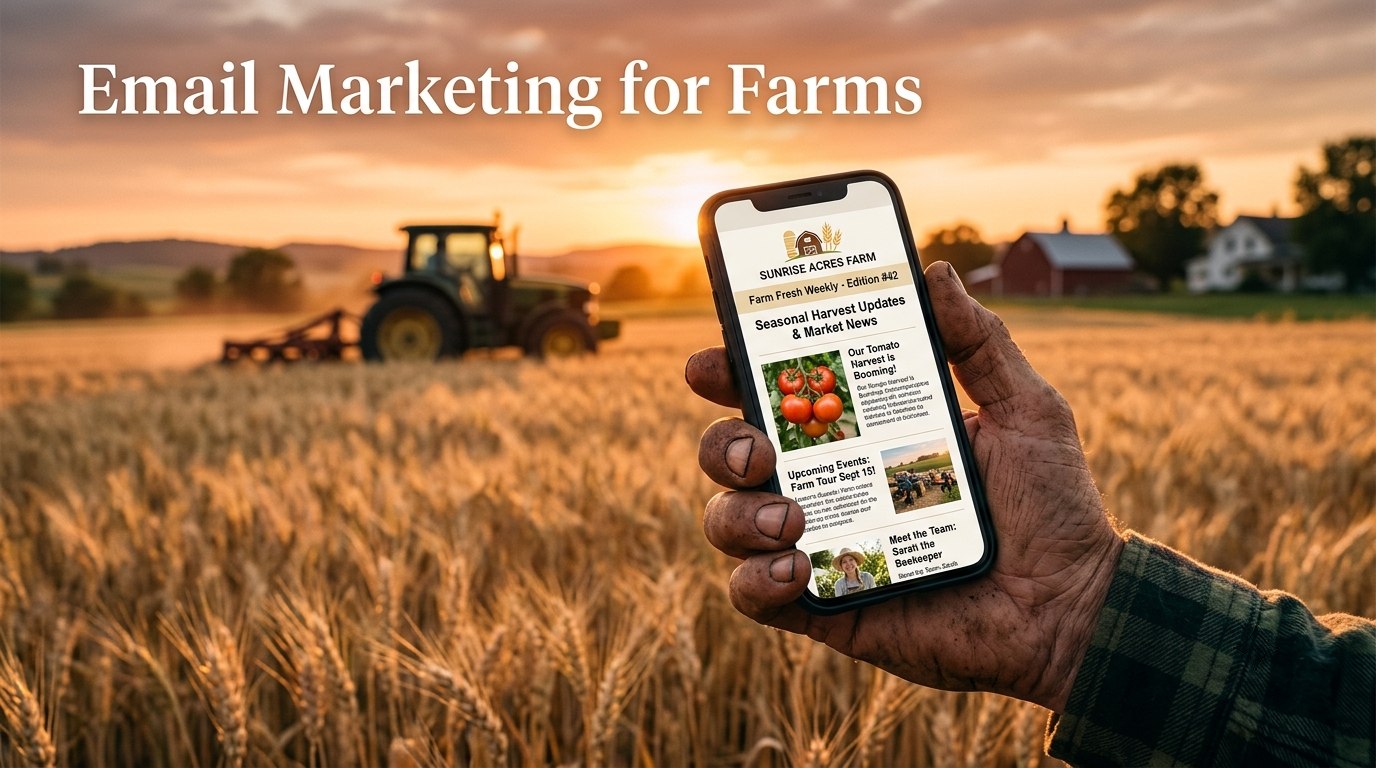
Let me ask you something honest: when was the last time you opened an email from a farm or agribusiness and actually looked forward to reading it?
If you’re like most people, the answer is probably “rarely” or “never.” Most agricultural email is boring, salesy, or just plain irrelevant. It gets deleted, ignored, or worse — marked as spam.
But here’s the thing: email marketing is still the most effective digital marketing channel for agriculture. Not social media. Not SEO. Not paid ads.
Why? Because email is personal, direct, and owned by you. Unlike social media platforms that change algorithms on a whim, your email list is an asset you control completely. People who have given you permission to email them are people who are genuinely interested in what you do.
This guide will show you how to build an email marketing strategy that actually works for agriculture. No fluff. No complicated jargon. Just practical, field-tested approaches that respect your time and your subscribers’ inboxes.
H2: Why Email Marketing Matters More Than You Think
H3: The Numbers Don’t Lie
- Return on Investment: Email marketing generates an average ROI of $42 for every $1 spent . That’s higher than any other digital marketing channel.
- Reach: Email reaches 4.2 billion users worldwide and is growing at 2.9% annually .
- Ownership: You own your email list. You don’t own your followers on Facebook, Instagram, or TikTok. If those platforms disappear, your audience vanishes with them.
- Preference: Research consistently shows that consumers prefer to receive marketing communications via email over any other channel. People actively check their email multiple times daily.
H3: Why Email Works for Agriculture
- Farmers check email: Despite stereotypes, farmers are connected. They check email for market reports, weather updates, and industry news.
- Seasonal timing: Email lets you reach people at the right time — just before seeding, during harvest, or when seasonal decisions need to be made.
- Relationship building: Good email marketing isn’t about selling. It’s about building trust. And in agriculture, trust is everything.
H2: Building Your Email List the Right Way
You can’t send emails without subscribers. Here’s how to grow your list ethically and effectively.
H3: Start With What You Already Have
Before you do anything else, gather the contacts you already have:
- Customer database: Everyone who has bought from you, visited your farm, or inquired about your products
- Social media followers: People who already follow you online
- Website visitors: People who have visited your website
- Event attendees: People who have visited your stall at markets or field days
- Business cards: Contacts you’ve collected over the years
H3: Where to Collect Emails
| Location | Strategy |
|---|---|
| Farm gate | A simple sign: “Join our mailing list for seasonal updates and exclusive offers” with a QR code |
| Farmers markets | A clipboard with a sign-up sheet. Offer a small incentive (a discount code, a free recipe card) |
| Website | A prominent sign-up form. Simple, clear, and with a clear benefit |
| Social media | “Link in bio” to a sign-up page. Run a simple campaign: “Get our seasonal newsletter” |
| Order process | Add an opt-in checkbox during checkout |
| Invoices and receipts | A line at the bottom: “Want updates? Sign up at [link]” |
H3: What to Offer in Exchange for an Email
People don’t give away their email for nothing. You need to offer something valuable:
- Exclusive content: “Join our mailing list for tips, recipes, and behind-the-scenes content”
- Early access: “Be the first to know when our [product] is available”
- Discount code: “Sign up and get 10% off your first order”
- Useful guide: “Download our free guide to [topical issue]”
- Seasonal updates: “Get our seasonal availability updates before anyone else”
H3: The Double Opt-In
Do: Use double opt-in. This means people confirm their email after signing up. Why? It ensures genuine interest, reduces spam complaints, and builds a higher-quality list.
Don’t: Buy email lists. This is ineffective, often illegal, and damages your reputation.
H2: Choosing the Right Email Marketing Platform
You don’t need expensive software to get started. Many platforms offer free plans for small lists.
H3: Recommended Platforms for Agriculture
| Platform | Best For | Free Plan |
|---|---|---|
| Mailchimp | Beginners, simple campaigns | Up to 500 contacts, 1,000 sends/month |
| MailerLite | Simplicity, great support | Up to 1,000 subscribers, 12,000 sends/month |
| ConvertKit | Creators, bloggers, content-focused | Up to 1,000 subscribers |
| Brevo (Sendinblue) | SMS + email, transactional emails | Up to 300 emails/day, unlimited contacts |
| AWeber | Established businesses, features | Up to 500 subscribers, 3,000 sends/month |
| Ghost | Newsletter-focused, minimal design | Free for up to 100 subscribers |
Recommendation for farmers: Start with MailerLite or ConvertKit. They’re simple, affordable, and well-suited to content-focused marketing.
H2: What to Send — Content Ideas for Agricultural Emails
This is the most important section. The content you send determines whether people open, read, and engage with your emails.
H3: The Four Types of Agricultural Emails
1. Seasonal Updates (The Must-Have)
Align your emails with the rhythm of farming.
Examples:
- “What we’re planting this spring”
- “Our summer produce line-up”
- “Harvest update and availability”
- “Pre-winter preparation on the farm”
- “What’s happening in the paddock this month”
Why it works: Seasonal content is always relevant. It shows you’re connected to the land and gives subscribers a reason to stay subscribed year-round.
2. Educational Content (Builds Authority)
Share your knowledge.
Examples:
- “How to store potatoes for maximum freshness”
- “Understanding grass-fed beef vs grain-fed”
- “The science behind our rotational grazing”
- “Why soil health matters (and what we’re doing about it)”
- “5 common misconceptions about [your product]”
Why it works: Educational content positions you as an expert. It provides value without asking for anything in return. This builds trust.
3. Behind-the-Scenes (Connects Emotionally)
Give people a window into your world.
Examples:
- “A day in the life on our farm” (with photos)
- “Introducing our new [animal/product]”
- “What we’re grateful for this season”
- “Challenges we’re facing and how we’re adapting”
- “Meet the team: [Person’s name]”
Why it works: Behind-the-scenes content humanises your brand. It builds emotional connection and loyalty.
4. Promotional (Drives Sales)
This is where you actually ask for the sale.
Examples:
- “New season [product] now available”
- “Limited stock alert: [product] almost gone”
- “Special offer for our subscribers”
- “Farm-gate opening hours this month”
- “Get your [product] before they’re all gone”
Why it works: People on your list are already interested. They want to know when they can buy. Just don’t make every email about selling.
H3: The “Meat and Vegetables” Rule
Think of your email content like a meal:
- The meat (value): Educational content, stories, behind-the-scenes
- The vegetables (engagement): Questions, surveys, requests for feedback
- The dessert (promotion): The sale, the offer, the call to action
A good email has all three. But if you only serve dessert, people get sick of it.
H2: Structuring Your Email for Maximum Engagement
H3: The Anatomy of an Effective Agricultural Email
1. Subject Line (The Hook)
Your subject line determines whether your email gets opened. Here’s what works:
- Specificity: “Your summer vegetable guide” beats “Our newsletter”
- Curiosity: “What happened in the paddock this week?” beats “Farm update”
- Urgency: “Only 3 boxes left this season” beats “Stock available”
- Personalisation: “[Name], check out what’s new” beats “What’s new”
Subject line length: Aim for 6-10 words. On mobile, shorter subject lines perform better.
Examples of good agriculture subject lines:
- “New season apples are here 🍎 (and they’re delicious)”
- “What we’re planting next week (and why)”
- “The drought update you asked for”
- “Recipe inside: our favourite way to cook [product]”
- “Last call for summer produce boxes”
2. Preheader Text (The Second Hook)
The preheader is the preview text that appears after the subject line in most email clients. Use it to reinforce or extend your subject line.
Example:
- Subject: “New season apples are here 🍎”
- Preheader: “And they’re the sweetest we’ve grown in years”
3. Opening (The Greeting)
Keep it warm, simple, and personal.
- “Hi [Name],”
- “Hello from the farm…”
- “G’day [Name],”
- “Thank you for being part of our community”
4. Body (The Value)
This is where you deliver the promised content.
- Keep paragraphs short: 2-3 sentences max
- Use images: Show what you’re talking about
- Tell a story: Instead of “We have new potatoes,” try “On Monday morning, we pulled the first potatoes of the season from the ground. The soil was cool and damp, and the potatoes came up clean and perfect…”
- Include a clear point: What’s the one thing you want readers to take away?
5. Call to Action (The Action)
What do you want people to do?
- “Order now”
- “Read more”
- “Reply to this email”
- “Visit our farm gate”
- “Book your place”
- “Save this recipe”
Make your CTA clear, visible, and easy to click. Usually one primary CTA per email works best.
6. Closing (The Sign-Off)
End with warmth and personality.
- “Warm regards from the [Name] family”
- “Thanks for being part of our farm community”
- “Until next time, take care”
- “We’ll see you at the gate”
7. Footer (The Legal Bits)
Include:
- Unsubscribe link
- Your mailing address
- Privacy policy link
H3: The 80/20 Rule
Remember the 80/20 rule for email marketing:
- 80% of your emails should be valuable content (education, entertainment, connection)
- 20% of your emails should be promotional (sales, offers, direct calls to action)
This keeps your audience engaged and prevents them from unsubscribing.
H2: Email Frequency and Timing
H3: How Often Should You Send?
This depends on your audience and your content. General guidelines:
| Frequency | Who It’s For | Considerations |
|---|---|---|
| Weekly | Content-heavy brands, strong following | Keep each email valuable. Avoid filler. |
| Fortnightly | Most businesses (sweet spot) | Regular enough to stay top-of-mind; infrequent enough to avoid annoyance. |
| Monthly | Lower-frequency brands | Perfect for seasonal updates or newsletters. |
| Seasonal | Very low-frequency, highly seasonal | Only send when you have something meaningful to say. |
For agriculture specifically: Fortnightly to monthly is usually ideal. You want to stay in people’s minds without overwhelming them.
H3: Best Days and Times to Send
General best times for agricultural email marketing:
| Day | Time | Reasoning |
|---|---|---|
| Tuesday | 10-11am | Farmers and consumers alike are settled into their week |
| Thursday | 10-11am | Good for pre-weekend thinking |
| Saturday | 7-9am | Early morning checkers (farmers wake early) |
| Sunday | 7-9pm | Evening relaxers, planning for the week ahead |
Avoid: Monday mornings (everyone is catching up), Friday afternoons (people are distracted or checking out early), and late nights (unless your audience has indicated this works).
H3: Test and Adjust
Every audience is different. Send your emails at different times and check your open rates to see what works best. Most email platforms will give you basic analytics to track this.
H2: The “Farmer’s 6” — Building a System You Can Maintain
Marketing isn’t a sprint; it’s a marathon. Here’s a simple system that works for busy farmers.
H3: Step 1: Set Up Your System (Week 1-2)
- Choose an email platform (MailerLite or ConvertKit recommended)
- Set up your sign-up form (embed on website, create a link for social media)
- Create a welcome email (automated, sent when someone subscribes)
- Write 3-4 evergreen emails (content that stays relevant year-round)
- Plan your first 3 months (topics, timing, key seasonal moments)
H3: Step 2: Batch Content Creation (Monthly)
Set aside 2-3 hours at the start of each month to:
- Review the coming season: What’s happening on the farm?
- Choose your topics: 2-4 emails, based on what’s relevant
- Draft your content: Write the emails (or at least detailed outlines)
- Take photos: If you can, take seasonal photos in golden hour
- Schedule: Set up all emails to go out automatically
H3: Step 3: Measure What Matters
- Open rate: Aim for 25-40% (agriculture tends to be above average)
- Click-through rate: Aim for 2-5%
- Unsubscribe rate: Should be under 1% (if it’s higher, review your content)
Don’t obsess over numbers: A smaller, highly engaged list is worth more than a large, disengaged list.
H2: Advanced Email Marketing Techniques
Once you’ve mastered the basics, try these advanced approaches:
H3: Segment Your List
Not all subscribers are the same. Segment them for better targeting:
- Customers vs. Prospects: People who’ve bought from you vs. those who haven’t
- Interests: What products or topics they’re interested in
- Location: Local vs. regional vs. interstate
- Engagement: Active vs. inactive
Example: Send a “potato special” only to people who have expressed interest in vegetables. Send a “lamb order” only to meat buyers.
H3: Use Automation
Set up automated emails that send based on triggers:
- Welcome series: A sequence of 2-3 emails for new subscribers
- Abandoned cart: Remind people who left items in their online shopping cart
- Birthday/anniversary: Offer a special discount
- Post-purchase: Thank you, order confirmation, follow-up satisfaction survey
H3: A/B Test Subject Lines
Test different subject lines to see what works best:
Test 1: “New season produce available” vs “What’s fresh this week?”
Test 2: “Farm update: October” vs “October produce: the good, the bad, and the ugly”
Small tweaks can significantly improve your open rates.
H3: Use Personalisation
Beyond “Hi [Name]” you can personalise based on:
- Their interests: “We know you love tomatoes, so…”
- Their location: “Coming to the [local] market this weekend?”
- Their previous purchases: “Since you bought [product] last time, you might like…”
H3: Include Visuals
- Photo of the produce: Golden hour photos of your vegetables
- Photos of the farm: Behind-the-scenes images
- Team photos: Humanise your brand
- Before/after images: Show the results of your work
H3: The Value Add — Offer Something More
- Exclusive recipes: “Our family’s favourite recipe using [product]”
- Access to experts: “Ask [agronomist/vet/nutritionist] a question”
- Resources: “Download our seasonal planting guide”
- Referrals: “Want to share [product] with a friend? They get 15% off their first order”
H2: What Not to Do — Common Agricultural Email Mistakes
Mistake 1: The “We Just Wanted to Say Hi” Email
Sending an email with no actual content is the fastest way to lose subscribers.
Fix: Every email should have a clear purpose, even if it’s “just” an update.
Mistake 2: Hard Selling Every Time
If every email is a sales pitch, people unsubscribe.
Fix: Follow the 80/20 rule. Most emails should be value-add content.
Mistake 3: Over-Designing
Fancy, image-heavy emails often don’t render well on mobile. Complex designs also take time to create.
Fix: Keep it simple and text-focused. Clean, readable design beats flashy.
Mistake 4: Long, Unbroken Paragraphs
Agriculture is already text-heavy. Long paragraphs don’t get read.
Fix: Short paragraphs, bullet points, and clear headings make your content scannable.
Mistake 5: No Call to Action
Even your value-add emails should have a clear CTA.
Fix: Always tell people what you want them to do — even if it’s just “Reply and let us know your thoughts.”
Mistake 6: Forgetting Mobile
Many farmers check email on their phones in the paddock.
Fix: Keep emails narrow, use large text, and ensure buttons are big enough to tap with a finger.
Mistake 7: No Consent
Buying email lists or adding people without their permission is illegal in most places.
Fix: Always use double opt-in. It’s better to have fewer engaged subscribers than many disengaged people.
H2: Maintaining a Healthy Email List
H3: List Hygiene
- Remove unengaged subscribers: People who haven’t opened in 6 months
- Clean invalid addresses: Bounced emails should be removed after 2-3 attempts
- Segment by engagement: Send to engaged people more frequently than to disengaged
H3: When to Ask for Resubscription
If people haven’t opened your emails in a while, send a “Should we stay in touch?” email. If they don’t respond, remove them.
H3: Managing Unsubscribes
Unsubscribes are normal. They mean your list is healthy and that people who genuinely want to hear from you remain.
Do: Make unsubscribing easy. Hiding the unsubscribe link is bad practice and can damage your sender reputation.
Don’t: Take unsubscribes personally. It’s not about you; it’s about the subscriber’s inbox.
H3: Deliverability Best Practices
- Authenticate your domain: Use SPF, DKIM, and DMARC
- Clean your list regularly: Remove invalid addresses
- Send relevant content: Higher engagement = better deliverability
- Don’t buy lists: This ruins your sender reputation
- Monitor your reputation: Use tools like SenderScore
H2: The Long View — Why Email is a Marathon, Not a Sprint
Building an email list takes time. You won’t see results overnight. But every month, your list grows. Every season, your relationships deepen.
The farms that succeed with email marketing:
- Start before they need it: Building a list is easier when things are going well than when you’re desperate for sales
- Give more than they take: Consistently providing value builds trust
- Stay consistent: Even in tough times, their subscribers hear from them
- Maintain a human touch: Their emails feel like they come from real people, not corporations
H2: Quick Start Action Plan
Week 1: Foundation
- Choose an email platform (MailerLite or ConvertKit)
- Set up your account
- Add your existing contacts
- Create a simple sign-up form
- Embed it on your website and social media
Week 2: Content
- Write a welcome email (automated)
- Draft 2 value-add emails (educational or behind-the-scenes)
- Draft 1 promotional email
- Set them up for scheduling
Week 3: Schedule and Send
- Send your first email
- Check analytics
- Adjust for next time
Month 1: Review and Refine
- Review open and click rates
- Ask for feedback from subscribers
- Plan next month’s content
- Stay consistent
H2: Sample Agricultural Email Templates
Template 1: Seasonal Update (Value-Add)
Subject: What we’re growing this season 🌱
Preheader: And why we’re excited about it
Hi [Name],
It’s that time of year again. The soil is warming up, the days are getting longer, and we’re spending our mornings in the paddock preparing for the new season.
What’s going in the ground this year?
We’re planting three new varieties of tomatoes this season. We trialled them in a small patch last year, and honestly, we were blown away. They’ve got the old-school flavour that people keep asking for, with better disease resistance and higher yield.
We’re also expanding our pumpkin patch. Last year’s were so popular, we’ve almost doubled the area.
What’s happening right now:
- Soil preparation is well underway
- Seeds are germinating in the greenhouse
- We’re fixing up the watering system before the dry season hits
A challenge we’re facing
We’re having trouble with [specific pest/weather challenge]. We’re trying [specific solution]. It’s still early days, but we’re hopeful.
Grateful for
This week, I’m grateful for the rain we got last week. It wasn’t much, but it’s set us up nicely for planting.
Thanks for being part of our farm journey.
Warm regards,
[Your Name]
[Farm Name]
Template 2: Behind-the-Scenes (Connection)
Subject: A day in the life on our farm 📸
Preheader: (and why it matters)
G’day [Name],
Have you ever wondered what a typical day looks like on our farm?
Most people picture it as idyllic. And sometimes it is. But more often, it’s about solving problems before they happen, fixing things that shouldn’t have broken, and trying to stay one step ahead of the weather.
Here’s what yesterday looked like:
5:30am: Sunrise over the paddocks. I walked the sheep, checked water troughs, and made sure everyone was healthy.
7:00am: Breakfast with the family. My [partner/kids/parents] and I talked through today’s plan while we ate.
8:00am: We spent the morning moving fence lines for our rotational grazing system. It’s not glamorous, but it’s how we keep our pasture healthy and our stock well-fed.
12:00pm: Quick lunch. A sandwich in the ute while checking emails and phone messages.
1:00pm: We started bringing in the [crop/livestock product] for [processing/packaging]. This is where the hours can stretch long.
5:00pm: One more walk around the property to make sure everything was as it should be.
6:00pm: Dinner. A debrief on the day, final planning for tomorrow.
Why I’m telling you this
Because I want you to know where your [product] comes from. Not the sanitised version. The real version. The dusty boots, the early mornings, the late nights, and the deep satisfaction of doing work that matters.
That’s what you’re supporting when you choose our farm.
[Call to action: Buy, visit, read more]
Until next time,
[Your Name]
[Farm Name]
Template 3: Promotional (Sales)
Subject: New season [product] are here! 🍅
Preheader: And they’re absolutely delicious
Hi [Name],
It’s official: our first [product] of the season are ready.
What you need to know:
- Variety: [Name of variety]
- Flavour profile: Sweet, crisp, full of old-school flavour
- Harvested: Within the last 24 hours
- Price: [Price per unit]
- Availability: We have [number] boxes available this week
- How to order: Reply to this email or visit our farm gate
Our honest assessment
These are the best [product] we’ve grown in three seasons. The weather this year was perfect — warm days, cool nights, just enough rain. The flavour is incredible.
We’re only going to have [quantity available] so if you want some, you’ll need to get in quickly.
Customer feedback from last season
“I’ve been buying [your product] for years and these are the best I’ve ever had.”
— [Customer name]
“I’m not usually one to write reviews, but I had to say: these [product] are the reason I keep coming back.”
— [Customer name]
[Call to action: Order now, visit the farm gate, reply to this email]
Thank you for supporting our farm.
Warm regards,
[Your Name]
[Farm Name]